Navigating Differences: What Does Jewish Tradition Have to Say

We are living in a time of increasing divisions in so many spheres of our lives.  As Jews committed to taking action to turn the tide on climate change, how do we respond to these divisions, within our own community, with the broader climate movement, and with the world at large?  What does Jewish tradition have to say about navigating differences?

The rabbinic tradition elevates the importance of dialogue and disagreement over time and through its sources - in the Mishnah, in the Talmud, and even in the Shulkhan Arukh which is an attempt to codify Jewish law. The chevruta style of learning - learning in pairs, parsing over the minutiae of a given word or text as well as debating the larger issues of faith or philosophy or modes of exegesis - constitutes the heart of Jewish learning and, arguably, Jewish identity and Jewish life. Disagreements are included in our tradition and in our sacred texts as if to say, it is not only the end result that matters, but the conversations filled with dissent, differing opinions, and even sparring that also carry significance and are worthy of our study and contemplation.

The Babylonian Talmud in tractate Eruvin shares the following teaching:  

R. Abba stated in the name of Samuel: For three years there was a dispute between Beit Shammai (the House of Shammai) and Beit Hillel (the House of Hillel), the former asserting, ‘The halakha (the way of doing things) is in agreement with our views’ and the latter contending, ‘The halakha is in agreement with our views’. Then a bat kol (a Heavenly voice) came down and said, ‘[The utterances of] both are the words of the living God, but the halakha is in agreement with the rulings of Beit Hillel’. Since, however, both are the words of the living God’ what was it that entitled Beit Hillel to have the halakha fixed in agreement with their rulings? Because they were kindly and modest, and they studied their own rulings as well as those of Beit Shammai. (Babylonian Talmud, Eruvin 13b) 

This passage has much to teach us about how disputes have functioned within the Jewish community.  Firstly, the text treats both micro communities – Beit Hillel and Beit Shammai – as engaging in a holy pursuit.  “Both are the words of the living God.” Both are attempting to bring Godliness and holiness into the world.  Both are seeking truth and a path forward for their communities and beyond.  The mishnah in Pirkei Avot - the Ethics of our Fathers - states that some disagreements, including the disagreements between Beit Hillel and Beit Shammai, are considered to be “for the sake of heaven.”

Secondly, the halakha is ultimately fixed one way or the other - a path is chosen - so that the larger community can move forward together.  And within that path, there are practices and minhagim (customs) that vary among communities and those differences are embraced.  Finally, the teaching offers that it was the unique qualities of Beit Hillel that resulted in fixing the halakha according to their rulings.  Beit Hillel were kind and modest — qualities essential to building unity as well as community.  In addition, Beit Hillel not only studied their own rulings but they studied the rulings of Beit Shammai, as well.  They were good listeners.  They were open.  They took note of and tried to understand a perspective different from theirs, and used it to help inform their own teachings and their own perspective.  In short, they were good friends and they understood the importance of relationships.

As we continue to navigate a world filled with pain and uncertainty, with strife and conflict, with widening divisions and hurdles that threaten our ability to move forward together in a moment that requires us to move forward together, perhaps we can use Beit Hillel as a model for how to engage with those we disagree with and find common ground upon which we can progress in cooperation with each other.  We can do this by engaging with open minds, with kindness and humility, by channeling our capacity for deep listening, and by focusing in on and centering the person before us.  As we seek our path forward as Jews who have chosen to face the existential threat of climate change and take action, let us remember that we are participating in a heavenly pursuit – and that any disputes among us or with others in the larger climate movement can fall into that category of a holy dispute, a disagreement “for the sake of heaven.”

By Rachel Landsberg, JCAN NYC member

Why JCAN NYC Members Care So Much About Local Law 97

Mayor Adams is trying to gut Local Law 97, New York City’s Green New Deal for buildings.  Local Law 97 is designed to reduce emissions, improve air quality, create good green jobs and reduce energy costs. Mayor Adams has proposed regulations that create major loopholes and delays, jeopardizing these benefits. 

JCAN NYC has  joined with NYC coalition partners to demand that Mayor Adamas strengthen the proposed regulations.   First, landlords who are in the two-year delay program should be required to make deeper cuts in the future to compensate for their delay.  Second, the renewable energy credit loophole which allows big building owners to avoid retrofitting their buildings should be changed to only up to 30% over a building’s pollution limit. This is the amount the LL97 Advisory Council unanimously recommended, and Mayor Adams ignored. 

Mary Krieger and Jack Gorman, JCAN NYC members, will be joining other JCAN NYC members to testify this Tuesday, October  24th at the Department of Buildings’ hearing.  Read excerpts from their testimony explaining why they feel compelled to testify.  

Mary Krieger’s testimony

My name is Mary Krieger.   I am a member of the Jewish Climate Action Network NYC and It’s Easy Being Green.  

I worked hard with JCAN NYC to pass LL97 because as Jews we are commanded to choose life. I am submitting testimony today because I am outraged that under Mayor Adams, the Building Department is proposing rules which will undermine Local Law 97.

 As a retired teacher and grandmother, I worry that New York is no longer a safe, healthy place for my former students and granddaughter. Climate change brought on by the pollution LL97 is designed to limit has wreaked havoc with the weather. Hurricane Sandy imperiled one of my medically fragile students when his home was flooded and was uninhabitable.  Torrential downpours trap people in basement apartments and on flooded roads.  And this summer my asthmatic husband had to breathe polluted air from wildfires triggered by droughts.   How do the parents of the asthmatic children in the county with the highest rate of asthma in the nation, The Bronx, feel when their children struggle to breathe because of the additional pollution from fires triggered by climate change?

 Climate change is real. It’s already here and Mayor Adams can’t allow it to get worse. 

Jack Gorman’s testimony

My name is Jack Gorman and I live and work in the Bronx. I am a member of the Bronx Climate and Environmental Justice Network, a group that has brought together climate-concerned organizations from across the Bronx.

 When I was an intern in pediatrics at what is now the Morgan Stanley Children's Hospital in Washington Heights, I was regularly confronted with young children gasping for air from asthma attacks. Many of those children were severely ill and required emergency treatment and hospitalization. I watched fear-stricken parents sitting by their children's bedsides, praying for their recovery.

 As is well known, the Bronx has the highest asthma rates in New York State. Only years after my internship did I learn that the major reason for these sky-high rates of respiratory illness is air pollution caused by burning fossil fuels. I vowed to do all I can to ensure that Bronx children have cleaner air to breathe so that they can avoid these devastating asthma attacks.

For that reason, I applauded Local Law 97 when it was passed in 2019. Here is the road to cleaning up our city's air and meeting our climate commitments. Now, however, I am dismayed to see that Local Law 97 could be significantly weakened by the proposed regulatory rules. I am urging you on behalf of the children of the Bronx and all over our city to strengthen these rules so that Local Law 97 is fully implemented and enforced.

I know you will hear from wealthy real estate interests and building owners that it is too expensive to fully implement Local Law 97, but you know that this is patently untrue. Local Law 97 is practical and enforceable. We need it to save lives. Please make sure we have a strong and enforceable Local Law 97.


What Sukkot Can Teach Us About Living Through the Climate Era

This week, we celebrate Sukkot and the fall harvest.  We are reminded of the sukkot - the booths - that the Israelites dwelled in as they journeyed from Egypt to the land of Canaan. These sukkot symbolize both our vulnerability - being utterly exposed to the elements while living in a temporary structure with only three walls and barely a roof - as well as our faith - that God will protect us through this harrowing journey and that we will make it into the promised land.  In addition, Sukkot follows on the heels of Rosh Hashana and Yom Kippur, perhaps the two holiest holidays in the Jewish calendar. Rather than treating Sukkot as an afterthought, it can be seen as the culmination of these fall holidays. 

Rosh Hashana is considered hayom harat olam, the birthday of the world.  There is an order to the world and we have our place in that order.  As we stand in front of God as Creator, we reckon with our smallness and our limitations as well as our vast potential as one of God’s creatures.  Rosh Hashana is also yom hadin, the day of judgment on which we are on trial and God is our Judge.  As our life hangs in the balance, we pray to be written into the Book of Life for the year to come.  On Yom Kippur, this theme of living in the balance between life and death intensifies, as we deny ourselves food and drink and as some of us don a kittel, the same white robe that we are buried in.  We spend the day reciting vidui, the confessional prayer, in which we enumerate the ways we have missed the mark this past year, and we beseech God to have compassion on us.  On Rosh Hashana and Yom Kippur we look directly at our fragility and mortality.  We look death in the face.

We are then commanded to dwell in sukkot for seven days, beginning four days after Yom Kippur.  Sukkot is referred to as z’man simchateinu, the time of our joy.  We move out of the security and safety of our homes and into a fragile and slightly precarious structure.  And we are meant to rejoice.  What is this joy that we are to experience?  Rabbi Alan Lew suggests that “perhaps this joy is precisely the joy of being stripped naked, the joy of being flush with life, the joy of having nothing between our skin and the wind and the starlight, nothing between us and the world.  We have spent the past many weeks stripping ourselves naked – acknowledging our brokenness, allowing ourselves to see what we won’t usually look at, embracing the emptiness at the core of our experience, reducing our lives to a series of impulses that rise up and then fall away again… We have invited ourselves to entertain the possibility that we might die.  On Rosh Hashana it is written, we acknowledge, who will live and who will die, and by Yom Kippur we have acknowledged that it may very well be us who does.”

As the climate crisis intensifies, and as the impacts on our communities increase and are felt across the globe, we can take note of that brokenness that Rabbi Lew describes.  We can allow ourselves to reckon with our own fragility and mortality, feel the pain that comes with the overwhelming devastation that climate change causes, and face the fear of how great our losses will be in the years to come.

But we don’t stop there.  When we accept the possibility of death head on and in community, we are more able to then turn and embrace life fully, to recommit ourselves to being fully alive and to pursue life in every arena that we can. To be alive is joyous; it is our birthright.  We get to build deep relationships, to seek out connection, to take note of what we have and experience heartfelt gratitude, to marvel at the complex and beautiful world that God has created and our part in that world.  This joy at being alive can help nurture and sustain us as we continue our work.  And our work, in turn, can be joyous.

This Sukkot, may we hold close and dear the words we uttered on Rosh Hashana and Yom Kippur when we invoked God as melekh hafetz bahayim - God Who desires life, God Who wants us to choose life. May we choose life in the coming year.

By Rachel Landsberg, JCAN NYC member

We are All Under One Roof: The Power of an Interfaith Gathering by Women from the Global South

Originally written by Dr. Adriane Leveen for Third Act Faith

On September 19, I find myself heading down 44th Steet in Manhattan toward the United Nations while the UN is in session. I am invited by my friend Rabbi Ellen Bernstein, a member of Third Act Faith and an inspiring 30-year climate activist, to join a unique climate gathering at the United Nations Church Center. As I head to 44th and First Ave. I navigate through packed streets of representatives from member states heading to their own meetings with an energy and vitality one could feel in the air, including a focus on climate. I am at the UN with the hope that 75,000 marchers on Sunday September 17th have made their boisterous presence felt, and their demand for urgent action on the climate emergency met. Signals remain mixed but the March reminds world leaders that we are still here, holding them to account. When I arrive at my destination, I find a gathering of women from the Global South, all leaders in various climate groups, who refresh my determination to carry on as a witness and  participant in  our own Third Act Faith as we  search  for common ground.  

The meeting on September 19th is sponsored by a group called “Faith for our Planet” (FFOP). On one of their posters, this international faith-based NGO describes its focus on equipping faith leaders with the knowledge, networks and skills to inspire climate activism and mobilization in their local communities. As an example of their work, FFOP recently hosted training sessions with a particular emphasis on Global South nations that included Pakistan, Bangladesh, and The Gambia. FFOP relies on a crucial assumption – that religious leaders can inspire and incorporate their power and, crucially, the power of their faith traditions to act globally.

This particular women’s conference, “Faith in Her," took the group’s mission two steps further, raising the power and potential of female change makers focused on climate in the Global South and releasing a Declaration of Inclusivity at the end of the meeting. The organizer of the event, Farwah Gulamali Khataw, describes the Declaration as a series of “recommendations curated in consultation with a panel of women experts to enhance participation and representation of women of faith in the Global South” in climate leadership and international dialogue. One such example in the Declaration calls for an ecosystem of connection, another the expansion of  meaningful representation for women of different ethnic and religious identities within decision making groups.

The idea of more meaningful representation is of particular interest to me ever since I met and read the work of Professor Christina Ergas,  Assistant Professor in the Department of Sociology at The University of Tennessee, Knoxville. Doctor Ergas’s data definitely made an impression on me. It shows that effective climate decisions are made when a gathering’s participants contain a meaningful representation of  women.

Recent research on women in organizations demonstrates that in order for decision-making patterns to change, a critical mass of women in decision-making positions must be achieved. Women likely need to hold around one-third of decision making positions, otherwise their voices may be ignored, they may feel too intimidated to comment, or they may not be  particularly representative of women in general, having been selected because their views were consistent with the men in the organization (McKinsey and Company, 2007; Buckingham, 2010). [1]

 Simply put, things get done, progress is made when women are part of the decision making.

 And here I was in a room full of such women, many of whom represented South Asia and Africa. Rabbi  Bernstein eloquently captured the atmosphere:

I’m inspired by the opportunities that a conference particularly oriented toward women can bring to the climate crisis. Women have a special aptitude for nurturing relationship and communities and paying attention to the body and its intuitive wisdom.

“Faith in  Her” dares to imagine a network of religious faith leaders from a range of religious backgrounds – Hindu, Muslim, Buddhist, Sikh, Jewish and Christian. The conference was exhilarating and often moving. I would like to briefly introduce Third Act Faith to some of the extraordinary women who are standing up for our planet.

We were welcomed by the Rev. Dionne P. Boissière, the chaplain of the U.N.’s Church Center.  She spoke slowly and seemingly with difficulty due to a stammer. She  had discovered that if she whispered or if she sang, the stammer went away. She did both. Listening to her clear strong voice in song I felt that her determination, flexibility and joy was exactly the combination we needed to continue this uphill battle to save our planet.  

The  Minister of Environment, Hon. Rohey John Manjang, from the Republic of the Gambia emphasized the importance of female leadership in her country and concluded her comments by addressing the fact that we were all from different faith traditions but “are all under one roof” –the same vast and threatened sky. We burst into applause at this metaphor for the gathering and its potential to build on our collective power.

Speakers on the panel that followed included Nana Firman, senior ambassador from GreenFaith who learned to use the Koran’s reverence toward our planet to help inspire and motivate Muslims to engage in climate work. Ambassador Ismat Jahan, former permanent representative of Bangladesh to the UN, has long worked for the elimination of Discrimination against Women. She offered examples of women who fought fiercely to keep their families alive when facing drought or floods, obviously made worse by climate change. She reminded us that women in the Global South are the frontline. A third member of the panel,  Priyanka Srinivasa, focuses on equity, inclusion and belonging as a manager at the King County Department of Natural Resources and Parks in New York. She is also a co-founder of  #iWillGo Out – one of India’s largest protests against gender-based violence. Each of these women illustrate not only inspiring leadership but the ways in which gender and the repercussions of our rapidly warming planet are tightly entangled and call for creative solutions that will endure. Each speaker was inspired by their own faith backgrounds to work in climate, and yet the unity they felt for one another, and we felt with them, powerfully stood out.  

Rabbi Ellen Bernstein, another example of powerful female climate leadership, as well as a representative of the Jewish tradition at ‘Faith in Her,’ gave a beautiful keynote speech. Since the  conference was held between the Jewish New Year and Yom Kippur Rabbi Bernstein beautifully conveyed a message ‘rooted’ in Judaism that also captured our shared global concern,  ‘all of us  under one roof.’

 The Jewish New Year, Rosh Hashanah, is the day that the earth and all the creatures were born; each year at this time, we and the whole creation are renewed. The language of awe and renewal helps to tune me into the earth and its seasons. The trees communicating with each other through vast mycelial networks, the planets running their circuits in the sky, the very miracle that I am a breathing, pulsating being in this body speaking to you all.

The Hebrew word for Awe, yira, also carries the meaning of fear, dread, terror. And indeed this is true of the English word awe — when you consider the word aw-ful. The space between awe and fear is thin indeed. And this combination of awe and dread is my natural state these days. I am simultaneously awed by the connectedness that underlies all life, and horrified by the imminent possibilities of destruction when those connections break down.”[2]

This conference illustrates just how those connections can be renewed and strengthened. May it be so.


By By Dr. Adriane Leveen, Member of Third Act Faith Member and JCAN NYC

______________________________

[1] Women’s status and carbon dioxide emissions: A quantitative cross-national analysis

Christina Ergas, Richard York in Social Science Research; journal homepage: www.elsevier.com/locate/ssresearch

Recent research on women in organizations demonstrates that in order for decision-making patterns to change, a critical mass of women in decision-making positions must be achieved. Women likely need to hold around one-third of decision making positions, otherwise their voices may be ignored, they may feel too intimidated to comment, or they may not be particularly representative of women in general, having been selected because their views were consistent with the men in the organization (McKinsey and Company, 2007; Buckingham, 2010). As an example of  how more gender balanced representation can matter for the environment, a study for the European Commission found that local municipalities with a higher percentage of women in positions of authority have higher recycling rates than municipalities with fewer women managers (Buckingham et al., 2005).

     Similarly, a number of cross-national studies have shown that having a significant number of women in positions of power does affect decision-making outcomes. One such cross-national study identified differences in nations’ environmental treaty ratification based on percentage of women in parliament, i.e. nations with higher proportions of women in parliament ratify a greater number of environmental treaties (Norgaard and York, 2005). Likewise, a United Nations Development Report (2007) that looked at the years 1990–2004 documented that among the 70 most developed nations in the world,18 had stabilized or reduced their carbon emission. Of these 18 nations, 14 had a greater than average percentage of women as elected representatives (Buckingham, 2010). In addition, Shandra et al. (2008) found that in nations with a higher proportion of women’s nongovernmental organizations (NGOs) per capita rates of deforestation are lower. Given these results,women’s participation in the decision-making process may prove invaluable for addressing climate change.

[2] For a fuller version of Rabbi Bernstein’s remarks see https://religionnews.com/2023/09/19/love-and-compassion-how-women-can-address-the-climate-crisis/

An Invitation to Connect Tashlikh to the Climate Moment of Right Now

What is Tashlikh?

On Rosh Hashana afternoon, it is customary to go to the banks of a river or any flowing stream of water to perform Tashlikh. In some communities, it is traditional to recite a passage from the book of Micah (7:18-20) and from Psalms (118:5-9) before casting bread into the water to symbolize the casting away of our sins.

The name Tashlikh is derived from the book of Micah 7:19:  יָשׁ֣וּב יְרַחֲמֵ֔נוּ יִכְבֹּ֖שׁ עֲוֺנֹתֵ֑ינוּ וְתַשְׁלִ֛יךְ בִּמְצֻל֥וֹת יָ֖ם כׇּל־חַטֹּאותָֽם / God will have compassion on us, forgiving our iniquities; and hurl (vtashlikh) all of our sins into the depths of the sea.

This ceremony continues the theme of our prayers and hopes on Rosh Hashana.  We pray that God will forgive our shortcomings on this day of judgment and take us back in love and with compassion.  As we celebrate the birthday of the world, we embrace new beginnings and possibilities.

We perform this ritual at the water’s edge. Water plays an important role in Jewish tradition. In the Creation story, we read of the primordial waters that existed before earth itself and God’s spirit hovering over those waters.  The waters bring forth the first living things formed during Creation. Prophetic visions occur by the water. People sit by the waters of Babylon and weep. Flowing water symbolizes life, Torah, purification, renewal, and hope.

The Climate Moment of Right Now

This year as we perform Tashlikh, we invite you, with the additional kavanah below, to  reflect on the moment we are now in and to take note of the precariousness of our lives. Just as we are utterly dependent upon God for sustaining our existence, we are also utterly dependent on the stability of our climate to live. 

Let us move from the blasts of the shofar towards our own commitment to individual and communal pathways for climate action.  As we open our eyes to the urgency of this moment, let us join together in spirit with those marching in the streets of New York City this weekend calling for a sustainable   future for all.

Kavanah: Connecting to the Climate Moment of Right Now

We invite you to recite this additional Kavanah / Intention while standing at the water’s edge before casting bread into the water:

This year, as we cast away our sins while standing at that liminal place where the habitats of land   animals like us and the water creatures converge, let us take stock of planet Earth and of all of her living creatures. 

Let us grieve for the skies filled with smoke, the parched ground and sweltering heat in many corners of the world,  the fires and floods that sweep away lives and homes, the melting glaciers and rising seas, and the most vulnerable communities unfairly impacted across the globe.

Here at the water’s edge, we remember God’s spirit sweeping over the primordial water as God set out to create our beautiful and complex world teeming with life and possibility. 

Created btzelem elohim, in the image of God, let us assume our rightful role as active partners with God and as shomrei haadamah, protectors of the earth.

Let us now choose to face the challenges before us and step into this moment with power and resolve, individually and communally.  Let us turn our inaction into action, our indifference into determination and through each step, our despair into hope. 

And may God respond:

כִּֽי־מֵ֥י נֹ֙חַ֙ זֹ֣את לִ֔י אֲשֶׁ֣ר נִשְׁבַּ֗עְתִּי מֵעֲבֹ֥ר מֵי־נֹ֛חַ ע֖וֹד עַל־הָאָ֑רֶץ כֵּ֥ן נִשְׁבַּ֛עְתִּי מִקְּצֹ֥ף עָלַ֖יִךְ וּמִגְּעׇר־בָּֽךְ׃ כִּ֤י הֶהָרִים֙ יָמ֔וּשׁוּ וְהַגְּבָע֖וֹת תְּמוּטֶ֑ינָה וְחַסְדִּ֞י מֵאִתֵּ֣ךְ לֹא־יָמ֗וּשׁ וּבְרִ֤ית שְׁלוֹמִי֙ לֹ֣א תָמ֔וּט אָמַ֥ר מְרַחֲמֵ֖ךְ יְהֹוָֽה׃

For this is like the waters of Noah to Me; for just as I have sworn that the waters of Noah should no more flood the earth; so  have I sworn that I will not be angry with you, nor rebuke you. For the mountains may move and the hills shake; but My kindness shall not depart from you, nor shall my covenant of peace be  taken away - says God, who has taken you back in love.       -Isaiah 54: 9-10

Jewish Climate Action Network NYC

Thank you to Rachel Landsberg, Jeff Levy-Lyons and Ace Leveen for developing the Kavanah. For those of you who would like to study Jewish texts related to climate, we have the following dates set aside to learn about Jewish holidays from a climate perspective with Rachel Landsberg:  September 27, November 29, April 15 and June 3.   Please join us at monthly JCAN      meetings on the second Tuesday of each month.  Learn more at jcan-nyc.org; email us at info@jcan-nyc.org.

Tisha B'Av and the Climate Crisis

On Tisha B’Av, the ninth day of the month of Av, which this year falls on July 26, we will be remembering the destruction of the First and Second Temples and a number of other calamitous events that tradition dates to this day.

While many of the rituals (including fasting) of Tisha B’av mirror those observed on Yom Kippur, the holidays are fundamentally different.  Yom Kippur, the holiest day of the year, the day we look to the future and hope to commune with God, ends on a joyous note, while Tisha B’Av, a day of communal mourning commemorating tragedies that have befallen the Jewish people, is the saddest day of our year.

Although the First Temple was destroyed by the Babylonians and the Second by the Romans, the rabbis held the Jewish people responsible for these cataclysmic events, contending it was our nation’s errant behavior, sinning against God and each other, that caused the destruction.

Fast forward 2000+ years:  We find ourselves in a climate crisis that threatens all humankind, not just the Jewish people, and we are called on to act urgently to save our planet. We have the responsibility to act, for Jews and non-Jews alike.  

As we approach Tisha B’Av this year, mourning for the Jewish past, may we see the holiday as a wakeup call to protect Temple Earth for ourselves and future generations. At the end of the day, may we commit ourselves to do what we must do to protect all life on Earth.

By Rabbi Judith Edelstein, D.Min., JCAN NYC Member

Great Books for Summer

Looking for a great book to add to your summer reading list?  We asked our newsletter subscribers for their top picks. Here are recommendations from six JCAN NYC stalwarts: Michelle Friedman, Ace Levine, Rachel Landsberg, Lori Robinson, Wendy Seligson, and Jessi Thompson

  • Michelle Friedman calls To the End of the Land by the prominent Israeli author David Grossman “a beautiful if heartbreaking book about Israel, parenthood and missed opportunities.”

  • Rachel Landsberg suggests Braiding Sweetgrass  by Robin Wall Kimmerer. Rachel notes that the chapter on gratitude had particular resonance for her as a Jew with our rich tradition of expressing gratitude in both our everyday lives as well as on holidays and during life-cycle events.

  • Ace Levine offers three recommendations:

    • In  Zen and the Art of Saving the Planet, the great and gentle teacher Thich Nhat  Hanh, z"l,  along with Sister True Dedication,  offers  comfort and motivation for our climate work.  

    • A number of rabbis and educators active on climate have written short essays on the work ahead of us in The Sacred Earth: Jewish Perspectives  on Our Planet.

    • In The Ministry for the Future, Kim Stanley Robinson imagines concrete actions that can help stop the climate crisis or at least  begin mitigating what we have wrought.

  •  Lori Robinson touts Nature’s Best Hope by Douglas Tallamy, for its insights into how an urban space can support nature.

  • Wendy Seligson recommends Dave Robert’s newsletter and podcast Volts, which tracks on-the-ground scalable solutions. Wendy notes that it’s a great way to quickly get a sense of the interesting work people are doing on decarbonization.

  • Jessi Thompson applauds Hope in the Dark by Rebecca Solnit, which she found especially relevant to our work as activists.  Solnit talks about hope being an active choice, not a blind state of optimism. Jessi also loved The Overstory by Richard Powers, which speaks to the interconnectedness of all life. She writes, “The way Powers evokes the beauty and profundity of the natural world is just gorgeous.”

Progress = Hope

We climate activists, being human after all, have a slew of emotions rolling around in us. At least for me, it can be hard to clearly identify each emotion at any given moment, but the feeling we lean into (or at least try to lean into) is hopefulness. Hope is the renewable energy of the human spirit: without it our energy flags; with it, we can push forward in the face of anything or anyone trying to hold us back. And the thing that gives us the greatest dose of hope is progress.

Over the last couple of months, I was present at two events (one as a participant, one as more of an observer) that gave me a huge injection of hope. Here’s a brief summary of each. 

On Earth Day weekend, I was the MC at the first NY Jewish Climate Summit. In attendance at Temple Shaaray Tefila (TST) were more than 250 people representing multiple organizations, congregations, and various demographics. It was a full afternoon of connection, learning, planning, and making commitments.  During a pause in my MC responsibilities, I looked out from the bimah in TST’s sanctuary, and was struck by what I was seeing; a Jewish climate movement. That’s been the vision of many Jewish activists in organizations like Religious Action Center of Reform Judaism (RAC-NY), Dayenu, and, of course, JCAN NYC. I felt a rush of hope, not from work completed, but of a clear sign of progress.  

Then, earlier this month, I tabled for NY Renews (the driving force for climate justice in New York State)  at an event called Resilience & Resolve, which was convened by the Center for Earth Ethics. The program was a day of training for faith leaders around the city and state (and neighboring states) to help them find their voices, draw from their traditions, learn about the resources available to combat the climate crisis in and around NYC, and to become real leaders within their faith communities. We know how powerful faith leaders can be in making clear our responsibilities to care for creation, and to see so many gathered for that purpose was incredibly motivating. Of the many inspiring speakers (and there were a bunch) was VP Al Gore who at one point said, “De-nial ain’t just a river in Egypt and de-spair ain’t just a tire in the trunk”.  

Our usual measures of success are a good bill passed, a bad bill defeated, or a sense of momentum in the fight against vested interests who seek to maintain a harmful status quo. But just being in the company of fellow activists, especially at inter-generational gatherings, and witnessing the growing numbers of people–good people, smart people, dedicated people who have joined in this work– is something I revel in and invite you to revel in whenever the opportunity presents itself. We are not alone like Moses in the desert, feeling the weight of this moment as a burden we have to carry ourselves. We are supported by many, many allies who share our vision of a just future where all life on this planet can thrive.   

The Jewish Climate Summit  and Resilience & Resolve were clear and heartening signs of progress. And progress = hope.  

-Jeff Levy-Lyons, JCAN NYC co-director

Supporting LL97, NYC’s Groundbreaking Law to Increase Building Energy Efficiency and Reduce Air Pollution

Local Law 97 is groundbreaking legislation adopted by the City Council and signed by the mayor in 2019 that requires energy efficiency improvements in many of New York City’s residential buildings over 25,000 square feet.  Since over 70% of New York City’s carbon emissions come from buildings, LL97 is a crucial part of New York City’s strategy to reduce air polluting emissions and combat climate change.  It will also create tens of thousands of green jobs and lower utility costs.  For an excellent summary of Local Law 97, see the Urban Green Council’s description here.

How does Local Law 97 work?  What can buildings do?

Building pollution comes from two main sources: the boiler/furnace in the building and electricity for the building.  Local law 97 sets initial caps on each source of pollution and then lowers the cap every five years.  The first cap starts next year and runs until 2029.  Approximately 80% of buildings meet the cap for this period.  However, most buildings will need to increase their energy efficiency to meet the cap that goes into effect in 2029.  Buildings which do not comply are subject to a penalty of $269 per ton of climate pollution over the cap.

Building owners can meet the Local Law 97 requirements in various ways, with the optimal strategy for each building depending on the age of the building and building systems.  Many, perhaps most, buildings will save money over and above the cost of the upgrades the law requires, because their energy costs will decrease.  Financing is available to pay for the upgrades needed and the savings from reduced energy usage can help pay for the financing.  There are also many NYS and NYC incentive programs to help pay for the costs. The City of New York has established the NYC Accelerator, a free resource, to help buildings learn more about the best path to follow.

What challenges are we anticipating this summer or early fall?

The Department of Buildings is issuing draft rules to guide the implementation of Local Law 97.  There are two loopholes which, if included, could threaten Local Law 97:

1.       The first would create a loophole that lets landlords “buy out” of upgrading buildings by purchasing “Renewable Energy Credits (RECS).”   To ensure that Local Law 97 achieves the goal of reducing emissions (and the benefits of green jobs and clean air) the amount of RECS needs to be limited to no more than 30% of the pollution that exceeds the cap.

2.       The second loophole would create an overly broad exception for a “good faith” effort by landlords.  While some buildings may face unique circumstances where a good faith exception is fitting, it should be the exception not the rule.  Tight enforcement is necessary and achievable to meet the goals.

Segments of the real estate lobby are pushing to gut or severely weaken Local Law 97 in a number of ways, including through the rule-making process.

 What can you do to protect and preserve Local Law 97 during the rule-making process?

Be ready to raise your voice for strong enforcement of Local Law 97. This may involve rallies, comments on the draft rules and emails and calls to elected officials.  You can start now by contacting your Councilmember to tell them that you support Local Law 97 and want to see it enforced to reduce emissions in line with the original 2019 goals.

 Resources to help buildings get started complying with Local Law 97

In May 2023, JCAN NYC members listened to a panel of experts describe how to get started complying with Local Law 97 .  As New Yorkers, there are things we can do to help buildings ramp up for compliance.  Share this video recording, and the resources below, with your co-op board leaders, property manager, friends and neighbors:

 · Fact sheet from Kyra Armstrong, attorney with New York Lawyers for the Public Interest (NYLPI)

· Resources from the NYC Accelerator– the go-to starting point for Local Law 97 compliance, from Gledis Korra, account manager

· Decarbonization Roadmap for Multifamily Affordable Housing from Margaret Perkins, long time advocate with 350NYC.org,  who is actively engaging her building on complying with LL97.


-Wendy Seligson, JCAN NYC co-director

Looking Up

When my wife Judy and I moved to New York from California and joined Minyan M’at, one of the first things that we noticed was the enthusiasm with which the congregants sang “El Adon,” one of the opening prayers in the Shabbat morning service. The minyan members know a number of different melodies, some faster and more rhythmic, others slower, but they all mark a moment of vivid emotion in the service.

The poem itself, dating likely to the Middle Ages, is an example of the genre of piyyutim. Written as an acrostic, starting with aleph and moving through the entire Hebrew alphabet—a technique which not only favors learning of the text, but also marks the broad ambition of the poet to encompass the universe: no letter could be lacking in its account. It speaks of the angels and other heavenly beings that praise God and proclaim God’s sovereignty, joyously following divine commandments. It directly references the “lights” which God created, the sun and the moon and the numerous other lights. The lines which begin with mem and nun describe these lights: “Full of splendor, they radiate brightness. Their brilliance adorns the universe.” The following lines speak directly of their orderly movements: “Rejoicing in rising and exalting in setting, with reverence they obey the will of their creator.” 

These other lights may simply be stars, or they may be astrological references to the planets. The poem names specific divine attributes (justice, mercy, goodness, purity, and so forth), which can be aligned directly with the visible planets—a tricky balance for Jews, since idolatry is so severely forbidden (the Talmud often uses the phrase “servants of the stars” to refer to pagans), but the order of the divine creation is open to our attentive examination and to the exploration of the clues offered in our texts, particularly the visions of angels contained in Isaiah and Ezekiel.

Is this poem simply an opportunity for us to encounter the deep piety of our forebears, for whom angels were real presences in the world, evidenced to them by text and experience alike. We are distant both from their worldviews and their connections with the skies. The daily and annual cycles of the sun shaped their lives much more than ours, and the moon—always full at Sukkot, Purim and Pesach—marked the approach of the holidays for people who did not receive synagogue newsletters in their inboxes. The night skies over even the largest of the medieval cities would have been dark enough for numerous stars to be visible.

I think that we can find something more, something that speaks to our current lives and concerns. Surprisingly, Manhattan is an unusually privileged place to see the movement of the sun from its southernmost position at the winter solstice in December to the northernmost  point at the summer solstice in June: we can see its movement through the grid of buildings if we are attentive, not merely at the twice-annual occurrence at Manhattanhenge. The moon, too, is a presence in our skies. For those of us on the Upper West Side, Riverside Drive offers numerous spots with open views to the west, where the crescent moon and the evening star are visible. I invite you to join me in subscribing to EarthSky, earthsky.org, a nonprofit which sends monthly updates on the planets that are visible in the night sky. Venus and Jupiter are bright enough to be seen nearly all the time in our neighborhood, urban though it may be; Mars and Saturn often are as well, and Mercury can pop into view with the simplest of binoculars.

These reminders to stop, to look up and to wonder have helped build my awareness of the lights in the sky. I do not think of them as literally obeying divine commandments, but their movements are inspiring nonetheless, testifying to the regularity and coherence that govern the universe.

The medieval poet understood that we humans inhabit a vast universe, with the earth below and the heavens above. In that view, our earth is often chaotic, and forces like human willfulness, greed and hatred create destruction, while the heavens—directly visible above us, displaying a profound harmony and order—are a source of reverence and hope.

We, too, are keenly aware of the greater order elsewhere in the solar system, galaxy and universe than down here on earth. Indeed, we understand the disturbances in our earthly realm as extending into the atmosphere that we have been filling with greenhouse gasses.  (As I write, the sky outside my window is a hazy color, due to smoke from wildfires in Nova Scotia.)  Though our view of order is different from the poet’s, we both live on an earth from which the heavens are in view. The skies can show us—as they showed the poet—the opportunities for our actions to restore on earth the order that is in plain sight above.

- Ben Orlove, JCAN NYC member

JCAN NYC Testimony - February 12, 2023

Jewish Climate Action Network NYC Testimony before the
2023 Environmental Conservation Joint Legislative Budget Hearing
February 14, 2023

My name is Wendy Seligson. I am here today as co-director of the Jewish Climate Action Network NYC and a resident of the Bronx.

I am testifying today because our Jewish tradition compels us to act to address the climate crisis before us in order to preserve and protect the Earth and all of its creatures. 

We join in this holy work with a growing movement of Jews inspired to act because of that tradition.  Our members are from all denominations – Reform, Conservative, Reconstructionist and Orthodox – as well as those who simply identify as being Jewish.

Jewish tradition calls us to act.

When Rabbi Joshua Heschel returned from Selma during the civil rights movement, he was asked, ‘Did you find much time to pray, when you were in Selma?’ He famously responded, ‘I prayed with my feet.’ 

Jewish tradition calls us to love, care for and protect the earth as its guardians- in Hebrew, Shomrei Adamah.   

Jewish tradition calls us to revere our planet, to recognize it as a living dynamic being, having value beyond any one generation, and to fight for its survival for the generations to come. 

We are also commanded in the Torah to love those who have been “othered” because we too were “othered” when we were slaves in Egypt.

As a JCAN member has so eloquently said: ‘This story, then, not only points us inward, it also points us outward.  We must love those who are “othered,” to take note of them and hold them as precious human beings, and we must stand with them and fight alongside them as we fought for ourselves when we were oppressed.’

Thus, guided by our tradition, we are asking you to act boldly to meet the climate crisis on the scale needed and to do so with justice for those who have been othered. 

  • We ask that you fund $10 billion for climate justice in this year’s budget. Such a significant increase in climate and environmental justice funding is contained in several key funding proposals before you and it is achievable—with your support.

  • We ask that you authorize the Climate and Community Protection Fund (CCPF) proposed by NY Renews.  It is built around climate justice – to care for the other - so that communities, workers and small businesses thrive as we work as meet the mandates of the 2019 climate law and transition to renewable energy.

  • We ask that you dig into the details and support the larger legislative climate roadmap.  This includes the Climate, Jobs, and Justice Package (CJJP), which lays the groundwork for a just and equitable energy transition (Read more about the bills here: bit.ly/CJJPBills101) and other climate proposals before you as well, including electrification of new buildings as quickly as possible.  

Join us in praying with your feet. Care for the stranger.  Make this the year that we provide for all New Yorkers and lead the nation in caring for the earth. 

By Wendy Seligson
JCAN NYC Co-Director

My Jewish Climate Story

My Jewish climate story goes back to my childhood. I was born and raised in the Catskills where my Holocaust survivor parents worked a small chicken farm. Exploring the local forests as a child and later as a Girl Scout kindled my love and respect for the natural world.

In my teens I served as a hiking and camping counselor at Camp Ramah in the Berkshires and hiked many sections of the Appalachian Trail. Life took me to New York City where I went to college and medical school and also delved into Jewish tradition, especially at Drisha Institute, a pioneer in advanced Torah education for women. Today, my work as a psychiatrist has broadened to include private practice and a career teaching clergy the basics of active listening and first responder intervention. I’ve been privileged to develop and chair the pastoral counseling program at the innovative rabbinical school, Yeshivat Chovevei Torah (YCT).

I’m so proud that JCAN and YCT embrace climate justice as a core Jewish value and that this was highlighted in a recent lecture offered by the Drisha Institute. Listening to Rabbi Dr. Mayse’s talk, summarized below, offered me the opportunity to meld my two loves of Torah and nature.

------------------------------------------------------------------------------------------------------------------------------

In “As A Deep River Rises: Jewish Law, Theology, and Environmental Ethics,“ a talk sponsored by  the Drisha Institute for Jewish Education on December 11, 2022 Rabbi Dr. Ariel Evan Mayse of Stanford University explored how we can draw on Jewish tradition to frame a response to the climate crisis. Mayse issued a powerful call to action, naming the crisis the greatest moral and existential crisis of our day and urging all religions to take it with the utmost seriousness.

In his remarks, Dr. Mayse asked if sustainability is compatible with a culture that champions growth and individual accomplishment and values overcoming the natural world. He wondered if we’re capable of shifting to a different model that respects nature  and responds to the social and economic needs of the world’s diverse inhabitants.

Dr. Mayse finds the more usual responses to the climate crisis, including Bal tashchit (thou shalt not destroy) and Tikkun olum (repair the world), inadequate. He suggests that we consider what we hold holy in assigning value to things and in shaping our actions in response to the climate crisis and points to the story of the tower of Babel as a cautionary tale of hubris that demonstrates the danger of building higher and higher and valorizing technology.

He goes on to point out that in the book of Leviticus the land is not an object but a subject that interacts with its inhabitants in a web of reciprocity. And he notes that Jewish tort law as explicated in the Talmud adheres to an ethics grounded in obligation. So, just as it is imperative that people take responsibility for damage caused and return lost objects to their owners, we must consider the needs of communities devastated by climate destruction.

There’s so much more in Mayse’s talk; I highly recommend listening to his powerful lecture to gain fresh insight into Jewish perspectives on the climate crisis. Listen to his lecture here.

Michelle Friedman, JCAN NYC Steering Committee member

Reflecting On Climate Justice and Jewish Action Gathering

On November 20th, Jeff Levy-Lyons and I co-facilitated a virtual gathering on the topic:  “What We Mean When We Talk About Climate Justice: Preparing for Jewish Climate Action.” Our aim was to connect Jewish teachings and values to the issue of climate justice, and to inspire Jews living in New York State  to take  bold communal action, specifically to embrace the work needed now to fully fund the Climate Leadership and Community Protection Act (the CLCPA).

In talking about climate justice, we started with the idea that climate change impacts different people differently and that these differences are not simply happenstance. Rather, historical and societal oppressions are at play that place some communities in greater danger. These communities are hit first and worst by climate change and lack the resources needed to mitigate the impacts of the climate crisis.

 Luz Velez, a woman who had come to my attention through my research on this issue, lives in one of these communities. Luz suffers from severe respiratory illness as a direct result of environmental factors such as pollution unfairly foisted on her black and Latinx neighborhood in Buffalo. For Luz, the poor housing stock in her community translates into black mold and an uninsulated home which exacerbate her health issues. To further illustrate the impact of climate injustice I also shared stories about the disparate effects of extreme heat, storms and flooding on communities within New York.

As Jews, we have many points of reference from our tradition and our teachings that can help us  understand the oppression that individuals like Luz face and to gather the strength to fight injustice. At our meeting, I shared two stories from the Torah which have great meaning for me–the first concerns our bondage in Egypt and subsequent redemption.  Our liturgy and our holidays consistently point to the Exodus story in which individuals, such as Moses, who overcomes his feelings of inadequacy to stand up and speak up for an oppressed people, and Shiphrah and Puah, the two midwives who, despite their fear, defy Pharaoh's edict to kill Hebrew boys at birth and save the lives of Moses and other male infants. I believe that Moses, Shiphrah and Puah can serve as role models for us as we find our voices and dare to challenge a system that extracts resources from Mother Earth with utter disregard for the harm it causes to the planet and its inhabitants, especially those impacted by climate injustice. 

We are also commanded in the Torah to love those who have been “othered” because we too were “othered” when we were slaves in Egypt. This story, then, not only points us inward, it also points us outward.  We must love those who are “othered,” we must take note of them and hold them as precious human beings, and we must stand with them and fight alongside them as we fought for ourselves when we were oppressed. 

The second story I shared at our meeting takes place when we stood  at Mount Sinai and entered  into a covenant with God and with each other.  If the Exodus story is a story of liberation from– from slavery, from oppression, from greed, from de-humanization and from being “othered,” the story of standing at Har Sinai is the story of moving towards– towards covenant, towards commitment, towards partnership, towards relationship, towards balance and reciprocity, towards justice. At  Sinai, we accepted a radically new way of doing things–despite our fear of the unknown, we moved forward.

As we travel forward in time, from slavery in Egypt and standing at Mount Sinai thousands of years ago to New York State today let’s take our collective memory, experience and understanding as Jews to inspire us to follow in the footsteps of our ancestors to find our voices and to choose bold action, despite our fear and uncertainty. We are fortunate to live in a state whose residents fought hard and ultimately prevailed in pushing our representatives to pass landmark climate legislation in 2019, the Climate Leadership and Community Protection Act, also known as the CLCPA. 

The name of this legislation reflects central Jewish values that are needed at this time.  Regarding, “leadership,” the world is in dire need of bold leadership to tackle the climate crisis, and, as Moses, Shiphrah and Puah demonstrated,  each of us, no matter how small we may feel standing up to the most powerful industry the world has ever known, can each find our voice from deep within and stand up as leaders in this fight for our planet. As for “community protection,” the term reminds us of the Jewish value of loving those who have been “othered” and ensuring that they and their needs are centered as we move forward in building a world that is sustainable and just for all.

The task this year is to fully fund the CLCPA so that we can rapidly bring down emissions,  build out renewables, and invest in communities, especially low income communities and communities of color, that have been hit hardest by the climate crisis.  The campaign that was launched a couple of weeks ago by NY Renews, the Climate Jobs and Justice Package, champions a number of bills designed to fund each  component of the CLCPA by raising capital and empowering state agencies to build renewables and shut down fossil fuel infrastructure. Those who join this campaign will be making calls to and meeting with  elected officials, showing up at rallies across the state, and participating in social media days of action in order to get these bills passed. Let’s show up to these actions as Jews, with a strong sense of who we are, where we come from and what kind of a world we want to build.

As we prepare to celebrate Chanukah and light candles next week, let us re-commit to finding more ways to bring light, hope and possibility into the darkness and transform our world.

- By Rachel Landsberg

COP27 Comes to a Close

The COP is Almost Over,
But the Final Outcomes Are Still Unclear

I am writing about COP27, the major international climate conference in Egypt, on the afternoon of Friday, November 18, 2022. As its name suggests, it’s the 27th in a series of conferences—held every year except for 2020, during the early phases of the pandemic; these are run by the United Nations Framework Convention on Climate Change (UNFCCC), bringing together all the nations of the world to reach agreements on how to address climate change. 


Though the conference is scheduled to end today, it will surely run past its deadline, as previous COPs have. And, like other COPs, many actors take firm stands, both from sincere concerns and goals and from the wish to stake out positions so they give as little ground as possible. Countries issue statements, directly or obliquely, and many other civil society organizations are present, even if they do not directly negotiate. The UNFCCC publishes some draft documents, and many participants write on blogs and Twitter, so it’s possible to get some sense of where things are headed. Here are some point:

  1. The 1.5°C warming limit is much debated. We’ve already had 1.2°C of warming, and would need to make utterly heroic efforts to stay within 1.5°C. Moreover, the Paris Agreement never set it up as a form limit; instead, it spoke, in characteristic diplomatic ambiguity, of limiting global warming to well below 2°C and pursuing efforts to limit it to 1.5°C. So there has been much attention at the COP to whether there will be recognition that the world will likely pass 1.4°C by some point in the 2030s. Nonetheless, it’s important to keep up ambition, so many speak of “keeping 1.5°C alive.” Feelings are very strong on this issue. 

  2. Finance. The poor countries that suffer the worst impacts, but have contributed little to emissions, need money to shift to renewable energy and to adapt to climate (and to the item in point 3). Will the wealthy countries provide the funds? There are many debates about the total amount that should be spent, about the form in which funds should be allocated (grants vs. loans, for example), about the specific institutions and funds that should transfer them, and about the governance of those institutions and funds. Not easy. 

  3. Loss and damage. This has been emerging as the third pillar of climate action, along with mitigation and adaptation. This is, in essence, climate reparations—payments for harms that can’t be undone. It was proposed in the late 1990s by small island states, and an earlier COP, in 2013, created an “Implementation Mechanism” to address it, though wealthy countries have blocked requirements to pay for this area. But things are changing, and it seems likely there will be progress here. 

  4. Participation. With the positive elections in Brazil and the US, Lula and Biden came to the conference and gave encouragement. Brazil joined with Congo and Indonesia as the three major tropical forest nations (in South America, Africa, and Asia) to sharply reduce deforestation, for example. And the US Inflation Reduction Act was welcomed. But the leaders from China, India, and Russia did not attend. A serious gap since they are delaying reducing emissions, and their commitments are crucial. They have played a role in previous COPs, which spoke of “phasing down” coal rather than “phasing out” coal. They are taking some steps towards decarbonization, but these are smaller than what is needed. However, civil society groups are stronger each year. At least—something very important—the US and China are talking again. 

  5. Details. COP-watching is a sport of its own. To give only one example: one of my friends and colleagues is negotiating on agreements on adaptation. An early draft spoke of “transboundary risk”. If climate change increases drought risk in the US Southwest, reducing flow in the Colorado River, and creating the need for adaptation in that region, that risk spreads across the boundary to Mexico, which is part of the Colorado River watershed and used to receive more water from it. But that entire category of risk—think of the Rhine, the Nile, the Ganges, the Mekong, the Amazon—is now not mentioned in the key adaptation text. Or perhaps it will be brought back in at the last minute. It remains to be seen.

  6. All eyes on 2023. This COP, though important, is a prelude to the much more significant COP next year. This will be the “First Global Stocktake,” reviewing how much—or how little—the world has succeeded in meeting its powerful pledges in the Paris Agreement. A major assessment on energy, land use and emissions, on adaptation, on finance—with justice, and loss and damage included as well. So much of what is happening in this COP is setting up the parameters for COP28 and the global mins.

I went back on Twitter to follow Simon Evans (he’s the one I most rely on) and saw that John Kerry, the key US negotiator, just tested positive for Covid. And the key loss and damage text got watered down again, with vaguer wording about who will pay what, and pushing the start date for a key fund to 2024, after the mins. But he also is showing that African voices are stronger (and this is an African COP, taking place in Egypt) so it will be harder for developed countries to deny the claims from that continent. 

It’s close to sunset. Shabbat shalom. We will know more in the coming days.

Passover Lessons

The Lingering Lessons of Passover

Passover ended about two weeks ago and on the Jewish calendar we’re now counting the Omer and moving toward Shavuot and revelation. Still, we can be forgiven if we can still almost taste the matza on our tongues and hear the songs and our story in our ears. In fact, keeping the story of our journey from enslavement to redemption present with us all year long can offer us much needed guidance and strength as we struggle to find a way to address our climate crisis.

The word mitzrayim has two meanings. It’s the Hebrew name for ancient Egypt and it also means a narrow place; a place of constriction. As such, the word is used to help us see our ancestors’ liberation from enslavement in Egypt as moving from a place of constriction (which enslavement certainly is) and into a place of spaciousness (which freedom certainly ought to be). 

Psalm 118 captures this beautifully. The Psalmist writes, “From a narrow place, I called out to God; God answered me from the expanse”.

Without much imaginative thinking or poetic license, we can see how we are now in another kind of mitzrayim; a place of constriction. We’re experiencing the impacts of the climate crisis closing in on us as we hear the ticking of the clock telling us that we have limited time to prevent the worst impacts from being visited on future generations. It’s almost more than our psyches can hold and many people either run away from this overwhelming reality or fall into a pit of despair. 

So, how should the Jewish community be responding to this existential bind and what can our Passover story teach us that can inform our response? We’re told that we should hear the story as if each of us was personally brought out of Egypt. Why? I think the main reason is that if we can feel our way through the story, it can sensitize our hearts to the suffering of others, “…because we were slaves in Egypt”. It’s a spiritual technique to help us feel rachmanus (compassion). That’s a Jewish value. So, the first thing to come to grips with is that we are not allowed to turn away; we cannot be bystanders to something that is causing suffering, even if we’re overwhelmed at the magnitude of it. 

But there is another way to feel our way into the story and juice more wisdom that we can apply to our current circumstance. Let me recast the roles from the Passover story onto our current mitzrayim to see if it provides hints of a way through this narrow passage to redemption.

First, we need to identify Pharaoh. In our current story, Pharaoh has three heads: the fossil fuel industry that continues to put profit over people; the politicians held in the sway of those extractive industries through huge donations to their reelection campaigns; and the large financial institutions that continue to fund the harm. These three heads constitute the hardened heart of Pharaoh. It also should be mentioned that we are all complicit in propping up Pharaoh through the ways we live our lives and invest our money. But for now, let’s simply revisit the famous quote from Rabbi Abraham Joshua Heschel, “Some are guilty, but all are responsible”.

Speaking of responsibility, who is our Moses? Sadly, there is no single modern-day figure who can represent all of us, so… it falls to all of us to be Moses. I believe that the Jewish community is well cast in the role of Moses. When Moses kills the Egyptian slave master, he’s showing his hyper-sensitivity to injustice. I believe that’s our superpower; our sense of felt responsibility. We don’t act based on calculations. We feel something is wrong or unjust, we feel it in our kishkes, and that feeling, like Moses, moves us from a posture of, “Someone ought to do something about this” to “I need to do something about this”. 

But I’m guessing that this casting might seem daunting. You might be thinking, “Me? Moses? Are you kidding? Who am I to speak truth to power?” Well, isn’t that exactly how Moses felt standing in front of the burning bush? When the voice from the bush drafts Moses to go back to Egypt and demand that Pharaoh let the people go, Moses begins his evasive maneuvers. In one of the most famous lines in the entire story, Moses tells the voice, “I’m not a person of words”. And the voice from the bush responds with a remarkable phrase, “I’ll be with your mouth”. Even then Moses isn’t yet able to let go of his fear and grab ahold of his faith and he continues to try to wiggle out of the assignment. The voice then tells him that his brother, Aaron, will be with him, helping him, supporting him. This exchange tells us we don't need to be brave souls or master communicators to play the role of Moses. But perhaps we do need an Aaron. 

So, who is Aaron in our current story? Jewish Climate Action Network exists to support the Jewish community in taking climate action. It’s right there in our name. Moses needed someone at his side, helping him find the words, offering encouragement and counsel. In much the same way, JCAN provides education on the issues, easy to use tools for taking action, and help identifying the unique gifts of each person that can be deployed to speed up the work. So, that’s Aaron. 

Having the familiar cast members of this ancient drama recast into our current mitzrayim can clarify our situation and our place in it. We know who we need to stand up to; we know that we’re the ones we’ve been waiting for; and we know where to reach for resources to guide and support us. 

Let’s move forward with strength, and in community, and may God be with our mouths.

Finding Climate Hope in the Month of Nisan

Fighting for a healthy climate is tiring work. The stakes are unimaginably high, and progress is distressingly slow. Can we avert a bleak planetary future? Is “winning” against the climate crisis even possible?

On Pesach, we can answer  this question: Yes, it is. To find hope, consider this teaching of the Meor Einayim, the 18th century Hasidic Rebbe of Chernobyl – yes, that Chernobyl, in Ukraine: The Meor Einayim asks why, on the spiritual plane, Israelites deserved to be redeemed. After all, they were totally absorbed into Egyptian society and practiced idol worship. And even if they deserved it, who’s to say they would go along with God’s plan?

His answer: “In Egypt, Israel performed the entire Passover Seder that night in the form in which we do, and they told the story of the Exodus [before it even happened], for they believed that they would certainly leave Egypt...Through this act of chesed [loving-kindness] that they brought forth, Israel was redeemed. And through Nisan in the future we shall be again redeemed…”

Something strange certainly happened on the night of 15th Nisan in Egypt. The Torah says that the Jews ate the Korban Pesach [the Passover sacrifice], their first act of independence, and,  in the understanding of the Meor Einayim, they performed the very Seder we perform… before the Exodus even happened!

I believe the Meor Einayim is imparting a powerful lesson about redemption. Even if they did not literally recite the contents of the Maxwell House Haggadah, on a metaphorical level Israel must have told the story of the Exodus. Until that night, the depressing inevitability of slavery was fixed within them. A world without slavery was unimaginable. To be redeemed, they first had to dream of a different reality, to tell each other a revolutionary narrative new to world history: the strong shall not prevail, might does not make right, G-d cares for the downtrodden. Only by imagining, in some detail, how they might be redeemed, could they finally open their doors the following morning and journey towards the wilderness and redemption.

As we sit around the seder table, Egypt sits within us and around us. Climate change, that symptom of human ignorance, avarice, and short-sightedness, continues. War rages, viruses invade our bodies, and authoritarianism gnaws at our body politic. Yet redemption awaits. Disaster is not inevitable.

But to journey towards our redemption, we must first imagine it. For one week of the year, Pesach invites us to forget about our cynicism, our worry; set aside the gloom of inevitability that obscures our hopes for our lives and for the world. And dream big: what will a redeemed society look like? How will a healthy, functioning planet operate? And what is the surprising, hope-affirming story that will soon bring it about? Tell the story. Articulate the hope. Prepare for redemption.

By Rabbi Hody Nemes
JCAN NYC Steering Committee Member

Feel free to share the above teaching at your seder. And consider these wonderful resources to bring climate concerns to your seder table.

Climate Resources For Your Seder:

  1. Four Questions about Climate Change: An addition to the Four Questions – reminding us of the questions we refuse to ask and the actions we refuse to take to address climate change, from JCAN (of Massachusetts).

  2. A New Ecological Haggadah: Get inspired with help from Rabbi Ellen Bernstein, author of The Promise of the Land, a haggadah in conversation with nature. View highlights from last year’s Passover Earth Seder, starring Rabbi Bernstein and many talented participants, or order a copy of The Promise of the Land.

  3. Earth Justice Seder: Print or view this free Haggadah focused on environmental justice, courtesy of the Religious Action Center, COEJL, and GreenFaith.

Freedom from industrial farming: Consider limiting or eliminating meat, a major contributor to climate change, from your Pesach this year.

Juliana v. U.S.

Juliana v. U.S. is a case brought by 21 young people, ranging in age from 11 to late teens, who are pursuing a suit against the federal government for the breach of their constitutional rights to live in a sustainable climate. They seek to make explicit the legal obligation of the USA government to change course on their energy policies now. The US govt. must stop subsidizing the fossil fuel industry, presumably to be replaced by a clean energy infrastructure across our land. What a brilliant tactic to sue the US govt.! We all know that you have to pursue every avenue in our work-legal, political, legislative, personal, boycotts-and I applaud their efforts. When Cinematters at the Marlene Meyerson JCC Manhattan announced a screening of the movie about their case-Youth v. Govt.-I signed up immediately. I expected the movie to be compelling and even moving. Did I imagine that I would end up sobbing? Nope.

The young people were so committed, well informed and articulate about the many ways in which their lives were already being impacted by climate (hurricanes, drought, fires) and so determined, I wept. The lawyers working on their behalf were so fierce yet kind, and so determined, I wept. These are the people who call upon us to join them in their fierceness and determination-to keep on working together with them to save this planet.

I cried again while watching the numerous times their case kept getting delayed in the courts, hoped along with them when a judge ruled in their favor (to proceed with a trial which has yet to happen) and fumed watching them be deposed by DOJ lawyers who tried to intimidate them. The youth were NOT intimidated. They fought back, but at the same time they still managed to be kids who enjoyed mucking around, singing together and enjoying their time as a group. How could it be that it took these marvelous kids to stand up against this insanity?

The lawyers working on their behalf were also inspiring. A great scene in the film depicted the lawyers, after preparing for a crucial hearing in a hotel room conference table, get up, sing and dance, finding the energy together to face yet another courtroom, another judge, or three, knowing that the future of the 21 plaintiffs and the rest of their generation and ours, is at stake.

Where are they right now in this case that has yet to go to trial after 6 years? I received an email this week from the organization Our Children’s Trust that is continuing to work on this case:

“Juliana v. U.S., the landmark constitutional climate lawsuit brought in federal court by 21 youth against the U.S. government, are poised for significant results in the year ahead. Juliana v. U.S. continues to pursue their efforts to finally have their evidence heard in open court. For more than 6 years, these 21 youth have tenaciously and resiliently met every obfuscating effort of the prior administration, and now the current administration also, to prevent the facts of the U.S. government’s acceleration of the climate crisis from seeing the light of day at trial. We anticipate a ruling from the U.S. District Court in Juliana any day and are optimistic that the ruling will soon allow the children to present their constitutional evidence in open court at trial in federal court.”

To stay tuned and support their efforts, go to: https://www.ourchildrenstrust.org

I already have.

Ace Leveen,

JCAN NYC Co-Director

I Knew Nothing About Public Power

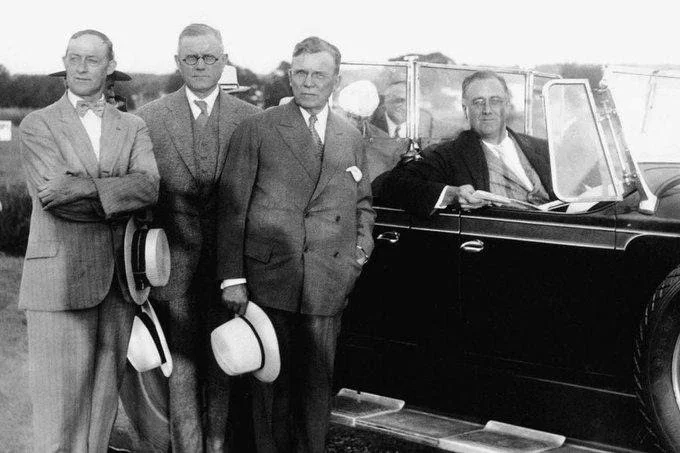
One year ago I knew nothing about public power, not even what the term “public power” meant. I first heard about public power from a former colleague of mine at Sane Energy Project, where I’ve served as a volunteer advisor for the past eight years. I soon learned that New York State has the largest public power utility in the country—the New York Power Authority (NYPA)—which generates 25% of the state’s power and provides some of the lowest cost electricity in the nation. Even better, 80% of the electricity NYPA generates is carbon-free.

Then governor Franklin Delano Roosevelt accompanies original NYPA Trustees on a visit to a potential hydroelectric site on the St. Lawrence River in 1931.

The Climate Leadership and Community Protection Act (CLCPA), adopted in 2019, requires that New York’s electricity sector become greenhouse-gas-emission free by 2040. Now, in the midst of the planetary crisis we find ourselves in, in a moment when speed is everything, I have no faith that for-profit utility companies (like Con Ed and National Grid) are going to move to renewable energy as quickly as the crisis demands. I was happy to learn that the Build Public Renewables Act (BPRA), which would expand NYPA’s capacity to provide 100% renewable energy to its customers, is moving forward in Albany. The law would also require NYPA to phase out existing non-renewable generation as quickly as possible and to hire current utility and fossil fuel workers for renewable energy jobs.

On January 13, I joined a spirited action in midtown Manhattan demanding that Governor Hochul include funding for the BPRA in her executive budget. I was thrilled to see hundreds of people gathered on the steps of the New York Public Library to hear passionate speeches by elected officials and activists calling on the governor to act now. From the library, we marched east to her office on Third Avenue. I knew that at least one of my colleagues at Sane Energy Project was going to risk arrest by engaging in civil disobedience, and I wanted to be there to support her. In the end ten people, including two of my Sane Energy colleagues and two assembly members, were arrested for blocking traffic.

Assembly Member Marcela Mitaynes, who represents Red Hook, Sunset Park, and northern Bay Ridge, is placed under arrest at the January 13, 2022 action.

On January 18, Governor Hochul shared her executive budget with New Yorkers. I’m disappointed she did not recognize the urgency of the moment and include the Build Public Renewables Act in it. We need this law to be enacted now. In the coming months, Sane Energy Project and other organizations will be pushing state lawmakers to include it in the budget that eventually goes to the governor for her signature. I hope you’ll join us.

Elliot Figman

JCAN NYC Member

Climate Crisis Gets Personal for Climate Activist/JCAN NYC Member

Testimony in favor of Intro 2317
November 17, 2021
Rabbi Hody Nemes
Jewish Climate Action Network NY

I’m Rabbi Hody Nemes, a co-founder and co-leader of Jewish Climate Action Network NYC, a group of New York Jews of many backgrounds, ages, and opinions who agree on one thing: we must act on climate change now. We stand upon the teachings, laws, and prophetic voices of Jewish tradition.

I’m here today because of my wife. On the night of September 1st, I thought she was going to die.

My wife is a pediatric emergency room doctor. Hurricane Ida was raging that night. But sick kids at the hospital needed her, so she went out into the storm.

She called me soon after leaving our house, frightened. She was on the Major Deegan and floodwaters were rising around her. Her car stalled twice. The waters kept rising, and rising. She called 911 and 311, but no one answered. For two hours, we wondered if she would survive. At home with our young children, I prayed. When EMTs finally rescued her, I cried. The car was lost, but my wife was saved.

She was lucky. Tragically, over fifty people died that night, in a storm that was certainly turbocharged by climate change.

I’ve studied climate change for years, but this was the first time it threatened my family directly. I finally understood that climate change can come for any one of us. We may not be the “stranger, the orphan, or the widow” right now, but we might be tomorrow.

That’s why we, like our partners in #GasFreeNYC, ask you to pass Intro 2317 this session. And to strengthen it, by (a) making it take effect in one year, not two, and (b) amending its text to ensure it more clearly covers gut renovations.

I’m not only afraid of drowning in storms, I’m afraid of suffocation. As an ER doctor, my wife has seen countless children threatened by asthma, particularly children from the South Bronx. According to the Rocky Mountain Institute’s estimate, more than 1,000 New Yorkers are killed annually by building pollution in this city.

That’s 1,000 New Yorkers too many.

Jewish tradition is obsessed with saving lives, from the very first chapters of Genesis onwards. In the words of our theologian Rabbi Yitz Greenberg, “The Torah’s central value — expressed in ritual and ethics — is to increase life and the quality of life in every act that we do.”

I ask you today - remember the people who died in Ida, remember the thousand choking to death on our air pollution, remember my wife terrified for her life.

Pass this bill.